null

Welcome to Moonlight Mysteries, your premier witch shop and witchcraft store. As one of the oldest, most established Wiccan stores online, we are the ultimate destination for occult & metaphysical supplies offering the highest-quality witchcraft supplies, wiccan tools, and authentic ritual spell ingredients since 2002. We have proudly served the online Pagan, Wiccan, and occult communities for over 20 years, priding ourselves on providing a superior shopping experience for the modern witch.  Whether you are searching for an online botanica, a metaphysical supply store, or a curated esoteric curiosity shop, our ever-growing catalog boasts over 4,500 magickal items to beautifully stock your ritual altar. We keep our doors open to all practitioners of the arcane—including Wiccans, Pagans, Hoodoo practitioners, rootworkers, Vodun devotees, the green witch, and New Age seekers—offering premium tools for every path. Our selection features bespoke spell candles, handcrafted botanical sets, Hoodoo conjuring supplies, and premium incense. From mystical witchy decor to traditionally used essential ritual oils for intention work, we know the discerning practitioner values authenticity. That is why all of our luxury witchcraft accoutrements are ethically sourced, expertly crafted, and handmade with deep intent.  Curated by practitioners, for practitioners, our premium goods are designed for every stage of the spiritual journey. Whether you are building a sacred space, restocking an apothecary, or searching for unique gifts for a solitary witch, you have found a reliable, high-end home for your spiritual practice. Enjoy free USA shipping on every order, with no minimum required. Explore the collection. Find your tools. Build your practice.

Lughnasadh 2026 | Witch's Complete Guide to the First Harvest Sabbat
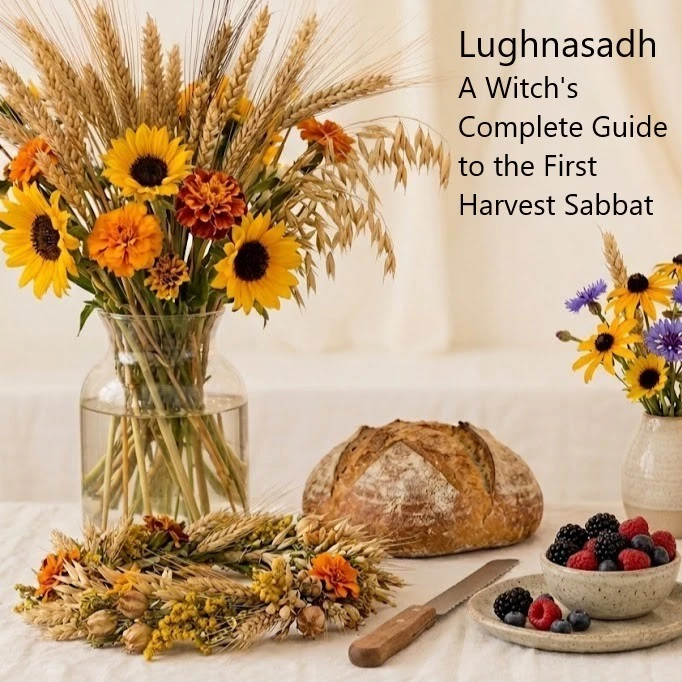
Lughnasadh 2026: The Complete Witch's Guide to the First Harvest Sabbat

Lughnasadh falls on August 1st, 2026 — the first of three harvest sabbats on the Wheel of the Year.

Most people think Lughnasadh is about abundance. It's not. It's about sacrifice — and what you're willing to cut down so something greater can be fed.

The grain doesn't volunteer. It is cut. The king of summer doesn't step aside gracefully. He falls so the harvest can live. Lughnasadh arrives at the peak of summer's golden power and asks the question that separates the practitioner from the dabbler: What are you willing to give up so your work can bear fruit?

This is the sabbat that separates intention from action. You planted at Imbolc. You tended through Beltane. You celebrated at Litha. Now the Wheel turns and the reckoning arrives — not as punishment, but as harvest. What grew? What didn't? What must be cut so the rest can thrive?

At Moonlight Mysteries — your trusted wiccan store — we've built the most complete Lughnasadh guide you'll find anywhere. History, mythology, deity lore, altar setup, rituals, spells, journaling prompts, traditional foods, and everything you need from our wiccan supplies and pagan supplies collection to make this first harvest sabbat unforgettable.

The harvest is here. Are you ready?

✦ What Is Lughnasadh? History, Mythology & Sacred Meaning ✦

Lughnasadh (pronounced LOO-nah-sah) is one of the four great fire festivals of the ancient Celtic calendar, falling on August 1st between the Summer Solstice and the Autumn Equinox. Along with Imbolc, Beltane, and Samhain, it marks one of the hinge points of the year — a moment when the veil between seasons thins and the energy of the earth shifts perceptibly.

The name means "the assembly of Lugh" — a festival established by the god Lugh himself in honor of his foster mother Tailtiu, the last queen of the Fir Bolg, who died of exhaustion after clearing the great plains of Ireland for agriculture. Her death fed a nation. Lugh's festival honors that sacrifice every year at the height of summer.

Lammas — the Anglo-Saxon name used interchangeably in modern Wiccan and pagan practice — comes from the Old English hlaf-maesse, meaning "loaf mass." It reflects the Christian overlay of the festival, when the first grain of the harvest was baked into bread and brought to church for blessing. The name changed. The energy didn't.

In the Wiccan Wheel of the Year, Lughnasadh is the first of three harvest sabbats:

  • Lughnasadh / Lammas (August 1st) — grain harvest, first fruits
  • Mabon (Autumn Equinox, ~September 22nd) — second harvest, balance
  • Samhain (October 31st) — final harvest, the thinning veil, the ancestors

Together they form the great arc of autumn — the descent of the light, the gathering of what was grown, and the preparation for the dark half of the year.

✦ Lugh: The God of the First Harvest ✦

To truly understand Lughnasadh, you must understand Lugh. He is one of the most complex and compelling figures in the Celtic pantheon — not a simple harvest god, not merely a sun deity, but something far more layered. Lugh is Lugh Lámhfhada — Lugh of the Long Hand — a title that speaks to his reach, his skill, and his mastery over distance and craft.

When Lugh arrived at the hall of the Tuatha Dé Danann and asked to be admitted, the doorkeeper asked what skill he brought. Lugh named one craft. The doorkeeper said they already had a master of that craft. Lugh named another. Same answer. He named every skill he possessed — warrior, harper, poet, sorcerer, craftsman, historian, hero — and each time was told they had no need of another master. Finally Lugh asked: "Do you have anyone who is master of all of them at once?"

The doors opened.

Lugh is the God of mastery, craft, skill, light, and the harvest sun. He is the one who holds all things together — the generalist who transcends specialization, the light that makes all growth possible. At Lughnasadh, we honor not just the harvest of the fields but the harvest of our own skills, our own work, our own creative output.

Working with Lugh at Lughnasadh:
  • Offer grain, bread, or mead at your altar
  • Light a gold or yellow candle in his honor
  • Dedicate a creative project or skill to his energy
  • Speak his name at dawn on August 1st and ask for mastery in your craft
  • Use citrine or golden topaz as his stone on your altar
Other deities honored at Lughnasadh:
  • Tailtiu — foster mother of Lugh, goddess of the cleared land and sacrifice
  • Demeter / Ceres — Greek and Roman grain goddesses, deeply resonant with this sabbat
  • The Grain Goddess — the feminine face of the harvest in Wiccan tradition
  • The Sacrificial God — the male principle who gives himself to the harvest, the John Barleycorn figure
  • Habondia / Abundantia — Goddess of abundance and prosperity

✦ Lughnasadh Themes for Your Practice in 2026 ✦

Every sabbat has its shadow side — the teaching beneath the celebration. Lughnasadh's surface is golden and abundant. Its depth is about sacrifice, discernment, and the courage to cut what isn't working.

The themes of Lughnasadh:

  • First harvest — reaping what you planted at Imbolc and tended through spring
  • Sacrifice — the grain must die to become bread; what must you release?
  • Gratitude — genuine, embodied thanks for what the earth and your own effort have produced
  • Skill and mastery — honoring Lugh by honoring your own craft
  • The turning light — the sun is still strong but the days are shortening; the dark is coming
  • Discernment — not everything that grew deserves to be harvested; some things must be composted
  • Community — Lughnasadh was historically a time of games, fairs, and gathering; connection matters
  • Transformation — grain becomes bread; raw becomes nourished; effort becomes result

Ask yourself as you approach this sabbat: What have I built this year? What am I proud of?

What needs to be cut before it drains the rest of the harvest?

✦ Lughnasadh Correspondences: Complete Reference ✦

Use this as your wiccan supplies and altar-building guide:

Date: August 1st (fixed) — August 1st, 2026 falls on a Saturday
Colors: Gold, amber, deep orange, russet brown, forest green, harvest yellow
Symbols: Wheat sheaves, corn dollies, bread loaves, sickles, scythes, sun wheels, baskets, sunflowers, cornucopias
Crystals & Stones: Citrine, carnelian, peridot, golden topaz, tiger's eye, amber, aventurine, sunstone, pyrite
Herbs & Botanicals: Wheat, corn, oats, barley, rye, sunflower, meadowsweet, heather, goldenrod, calendula, chamomile, blackberry, rosemary, vervain
Ritual Oils & Incense: Frankincense, sandalwood, rose, chamomile, heliotrope, sunflower, corn, wheat, cinnamon, clove
Deities: Lugh, Tailtiu, Demeter, Ceres, Habondia, the Grain Goddess, the Sacrificial God, John Barleycorn
Element: Earth & Fire
Candle Colors: Gold, orange, yellow, green, amber
Tarot: The Emperor (mastery, harvest of effort), The Wheel of Fortune (the turning), Strength (the courage to cut), The World (completion of a cycle)
Runes: Jera (harvest, cycles, right timing), Fehu (abundance, prosperity), Sowilo (the sun, Lugh's light), Ingwaz (completion, gestation)
Animals: Stag, eagle, lion, crow, horse, salmon
Trees: Oak, hazel, apple, ash

✦ Lughnasadh Altar Setup: Step by Step ✦

Your altar is your anchor for the sabbat. Here's how to build one that holds the full energy of the first harvest:

  1. Choose your altar cloth: Deep gold, amber, or harvest orange. Layer textures — linen, burlap, or velvet in harvest tones.
  2. Place your central symbols: A sheaf of wheat or dried grain, a small loaf of bread or corn dolly, a sickle or athame to represent the harvest cut.
  3. Set your candles: Gold for Lugh, green for the earth, orange for the turning season. A central pillar candle in deep amber works beautifully as a focal point.
  4. Add your crystals: Citrine for abundance and Lugh's solar energy, carnelian for vitality and the harvest fire, tiger's eye for discernment — knowing what to cut and what to keep.
  5. Place your offerings: Fresh bread, grain, blackberries, mead or apple cider, sunflower seeds. These are for Lugh, for Tailtiu, for the earth that fed you.
  6. Add your herbs and incense: Frankincense and sandalwood for sacred space, chamomile for gratitude, calendula for the sun's warmth. Loose incense on a charcoal disc is ideal for sabbat work.
  7. Include your tools: Your chalice for libations, your journal for harvest reflections, your Book of Shadows open to your Lughnasadh pages.
  8. Personalize: Add anything that represents YOUR harvest this year — a finished project, a photo, a symbol of something you've built. This is your harvest. Make it personal.

Find all the pagan supplies and witchcraft supplies you need for your Lughnasadh altar at Moonlight Mysteries — ritual candles, loose incense, crystals, altar cloths, chalices, and sacred tools chosen for the first harvest. (Shop Supplies Here)

✦ Lughnasadh Rituals for 2026 ✦

The First Harvest Gratitude Ritual

Best performed at dawn or noon on August 1st

You will need: Gold or orange candle, bread (homemade or artisan made if possible), chalice of mead, red wine or water, your journal, a small bowl for offerings.

  • Cleanse your space with smoke or sound.
  • Cast your circle as is your practice dictates.
  • Light your candle and sit in silence for a moment — feel the weight of the year so far.
  • Speak aloud three things you have harvested this year — not just materially, but emotionally, spiritually, creatively. Name them with specificity. Not "I grew as a person" but "I learned to hold my boundaries when it cost me something."
  • Hold the bread. Acknowledge what was sacrificed to make it — the grain, the labor, the earth's generosity. Take a moment with that.
  • Eat the bread mindfully. Take the harvest into your body.
  • Pour a libation into your offering bowl — mead, water, or cider — and speak: "To the earth that fed me, to Lugh who lit my way, to Tailtiu whose sacrifice made the fields possible — I give thanks."
  • Write in your journal: What did I plant at Ostara? What grew? What am I ready to release before Samhain?
  • Leave your offering bowl outside after the ritual.
Lugh's Mastery Candle Spell

For calling in skill, completion, and creative power

You will need: Gold or Yellow candle, sunflower or frankincense or sun oil, citrine, carving tool, paper and pen.

  • Write on paper the skill, project, or creative work you want to bring to fruition before the dark half of the year.
  • Anoint your candle with oil, drawing from the bottom upward toward the center and from the wick to the center to draw energy in.
  • Carve a symbol of your intention into the candle — a rune (Jera for harvest, Sowilo for Lugh's light), a sigil, or simply the first letter of your project.
  • Hold your citrine in both hands and charge it with your intention — feel the warmth of it, the solar energy.
  • Light the candle and speak: "Lugh of the long hand, master of all arts, I honor your light within me. As the grain is harvested, so too shall my work bear fruit. I am skilled. I am ready. I claim my harvest."
  • Burn your paper in the candle flame (safely) and let the intention release into the universe.
  • Let the candle burn down safely, keeping the citrine on your altar through the season.
The Corn Dolly Binding

A traditional Lughnasadh craft for intention-setting

Braid wheat stalks, corn husks, or dried grass into a simple figure — the spirit of the harvest given form. As you braid, speak your intentions for the coming dark half of the year into the figure. What do you want to gestate through autumn and winter? What seeds are you planting now for Imbolc?

Keep the corn dolly on your altar through Samhain. At Imbolc, burn or bury it to release those intentions back to the earth and make room for new growth.

The Sacrifice Fire Ritual

For releasing what no longer serves — best performed at dusk

You will need: A fireproof bowl or cauldron, paper, pen, matches.

  • Write on separate slips of paper everything you are ready to release — habits, relationships, projects, beliefs, fears, identities that no longer fit.
  • Hold each slip and feel the weight of it — don't rush this. Honor what it was, even if it no longer serves.
  • Speak: "I release what was planted that did not grow. I release what grew but is not mine to harvest. I make space for what is coming."
  • Burn each slip in your cauldron.
  • Scatter the ashes in the earth or running water.

✦ Lughnasadh by Tradition: How Different Paths Celebrate ✦

Wiccan Practice: In Wicca, Lughnasadh is one of the eight sabbats of the Wheel of the Year. The focus is on the sacrificial God — the sun king who gives his life so the harvest can live — and the Great Goddess in her Mother aspect, heavy with the abundance of the season. Rituals often include the baking of bread, the cutting of the first grain, and the honoring of the turning light.

Celtic Reconstructionist Practice: CR practitioners focus heavily on the historical festival — the games of Tailtiu, the assembly of Lugh, the athletic competitions and craft fairs that were central to the ancient celebration. Offerings to Lugh and Tailtiu are primary. The emphasis is on skill, community, and honoring the sacrifice of Tailtiu specifically.

Eclectic & Modern Pagan Practice: Eclectic practitioners draw from multiple traditions — combining Wiccan ritual structure with Celtic deity work, folk magic grain traditions, and personal harvest reflection. This is the most flexible approach and allows you to build a Lughnasadh practice that is entirely your own.

Solitary Practice: Lughnasadh is one of the most accessible sabbats for solitary practitioners. Baking and bread, building an altar, performing the gratitude ritual, and spending time in nature at dawn or noon on August 1st is a complete and powerful observance — no coven required.

✦ Lughnasadh Foods & the Sacred Act of Feasting ✦

Food is ritual at Lughnasadh. The act of baking, sharing, and eating is itself a sacred practice — the transformation of grain into bread mirrors the transformation the sabbat asks of us.

Traditional Lughnasadh foods:

  • Bread — bake a loaf from scratch, even a simple one. The act matters more than the recipe.
  • Corn on the cob — the most literal harvest food
  • Berry pies and tarts — blackberries are traditionally ripe at Lughnasadh across Celtic lands
  • Grain-based dishes — porridge, grain salads, barley soup
  • Mead, ale, red wine or apple cider — for libations and toasting Lugh
  • Sunflower seeds and nuts — offerings and snacks
  • Honey — the bees have been working all summer; honor their harvest too

The ritual of the first loaf: If you bake bread for Lughnasadh, cut the first slice and leave it as an offering before you eat any yourself. This is the oldest form of the sabbat — giving the first fruits back to the earth before taking your share.

✦ Lughnasadh Journaling Prompts for Witches ✦

Use these in your Book of Shadows, grimoire, or journal to deepen your practice:

  • What seeds did I plant — literally or metaphorically — at the start of this year?
  • What has grown beyond my expectations?
  • What did I tend carefully that still didn't flourish — and what does that teach me?
  • What am I ready to harvest and celebrate right now, without waiting for it to be perfect?
  • What must I sacrifice or release before the dark half of the year begins?
  • How am I honoring my own skills and craft this season?
  • What does Lugh's energy of mastery mean for my practice right now?
  • What would I plant differently if I could go back to Imbolc?
  • Who in my life has made a Tailtiu sacrifice for me — given something so I could grow?
  • What is the bread I am making from the grain of this year's effort?

Frequently Asked Questions About Lughnasadh

FAQ
+ When is Lughnasadh in 2026?
Lughnasadh falls on August 1st, 2026 — a Saturday. Some practitioners celebrate on the nearest full moon or on the astronomical cross-quarter day, which may fall a few days earlier or later.
FAQ
+ What is the difference between Lughnasadh and Lammas?
They are the same festival with different cultural origins. Lughnasadh is the Celtic name, rooted in the mythology of the god Lugh. Lammas is the Anglo-Saxon name meaning "loaf mass," reflecting the Christian tradition of blessing the first grain. Both are used in modern Wiccan and pagan practice — often interchangeably.
FAQ
+ How do witches celebrate Lughnasadh?
Witches celebrate Lughnasadh through altar building, ritual work, candle magic, baking bread, making corn dollies, performing gratitude and release rituals, working with harvest deities like Lugh and Demeter, and reflecting on what has grown and what must be released before the dark half of the year.
FAQ
+ What are traditional Lughnasadh offerings?
Traditional offerings include bread, grain, blackberries, mead, apple cider, sunflower seeds, and the first fruits of the harvest. These are left on the altar or placed outside for the earth, Lugh, and Tailtiu.
FAQ
+ What witchcraft supplies do I need for Lughnasadh?
For a complete Lughnasadh practice you'll want gold and orange ritual candles, loose incense (frankincense, chamomile, calendula), ritual oils for anointing, harvest crystals (citrine, carnelian, tiger's eye), an altar cloth in harvest colors, a chalice for libations, and a fireproof cauldron for release work. Find everything you need in our witchcraft supplies and wiccan supplies collection at Moonlight Mysteries.
FAQ
+ Is Lughnasadh the same as the harvest festival?
Lughnasadh is the first harvest festival on the Wiccan Wheel of the Year, followed by Mabon (second harvest) and Samhain (final harvest). Together they form the complete harvest arc of the year.
FAQ
+ Can solitaries celebrate Lughnasadh?
Absolutely. Lughnasadh is one of the most accessible sabbats for solitary practitioners. Baking bread, building an altar, performing a simple gratitude ritual, and spending time in nature on August 1st is a complete and meaningful observance.
FAQ
+ What is a corn dolly and how do I make one?
A corn dolly is a figure braided from wheat stalks, corn husks, or dried grass that represents the spirit of the harvest. To make one, braid your material into a simple human or cross shape while speaking your intentions into it. Keep it on your altar through Samhain, then burn or bury it at Imbolc to release those intentions back to the earth.

Your first harvest ritual deserves the right tools. At Moonlight Mysteries — is your trusted wiccan shop for premium wiccan supplies — every piece in our collection is chosen for practitioners who take their craft seriously. For your Lughnasadh altar and ritual work, explore:

Real witchcraft supplies for real practitioners — chosen with intention, shipped with care.
→ Shop Lughnasadh Witchcraft Supplies at Moonlight Mysteries

✦ Celebrating Lughnasadh Every Year ✦

The date changes. The energy doesn't.

Every August 1st, the grain is cut. Every year, the light turns. Every year, the witch stands at the threshold between summer's peak and autumn's approach and asks: What have I made of this light?

Return to this guide each Lughnasadh. Update your altar, revisit your journal entries from previous years, notice how your harvest has changed. Let the sabbat deepen with every turn of the Wheel — because the practitioner who has celebrated ten Lughnasadhs understands something the first-timer doesn't yet: the harvest is never just about this year. It's about the accumulation of all the years, all the plantings, all the cuttings, all the harvest.

The Wheel turns. The harvest comes. Reap it well.

Looking for more sabbat guides? Explore our complete: Wheel of the Year series — from Imbolc and Ostara to Samhain and Yule — all at Moonlight Mysteries, your trusted Wiccan store.

Blessed be, Moonlight Mysteries 

17th Jul 2026 Moonlight Mysteries

Newest Guide & Blog Updates